

Resources › For councils
Powering Up: a guide to electrification
Links and guidance to help councils move their buildings off gas, and support their communities to do the same.

Why electrify?
-
Electrification: To undergo a transition to be fossil fuel free, primarily by eliminating the use of natural gas.
For years, burning fossil fuels has been the predominant solution to generate heat and cook food, and have previously had lower carbon use than coal generated electricity. However, increasing demand and shift towards renewable energy makes existing gas infrastructure no longer the most affordable nor sustainable solution. Transitioning the built environment to all-electric is critical step in the clean energy revolution of today.
-
Net zero targets: The built environment is a significant contributor to our national GHG emissions, with 15% of total operational emissions accounted by natural gas (~14 million tonnes of CO2 a year). To keep average global temperature to below 1.5 degrees Celsius and minimise the impacts of human induced climate change, removing fossil fuels from buildings is one of the necessary steps to take.
Supporting documentation
Green Building Council Australia p. 5-6
Victorian Energy Collaboration (VECO): VECO is a large-scale renewable energy project that provides clean energy, generated from Victorian wind farms to 51 Victorian councils. Upgrading council owned-facilities to become all-electric will allow councils to use the renewable energy generated from VECO.
Health and safety: air pollution is an ongoing concern, contributing to high levels of morbidity and mortality in Australia. Burning natural gas, through heating and cooling, produces a range of harmful pollutants and fine particulates. These can have significant direct and indirect impact of the health and wellbeing of occupants and users.
Green Building Council Australia p. 9
Financial and operational resilience: as priorities and demands shift towards decarbonising the economy, energy costs increase. Gas assets become at risk of being a stranded asset, with increased costs due to rising cost in fossil fuels and changing consumer preferences for zero carbon. The need to retrofit assets away from fossil fuels will only become more important. All-electric buildings are becoming the more valuable, desirable and resilient asset.
-
Green Building Council Australia p. 29 - overview of capital and operating costs comparing gas and electric requirements.
Foundation Paper p. 41 - overview of probable cost and emissions reduction impact resulting from facility electrification.
-
Comparing an all-electric building to a building with natural gas should take into account a range of factors including:
Infrastructure costs
Energy and carbon costs
Lifecycle costs
Environmental costs and benefits
Resilience, regulatory and market benefits
Health, wellbeing and occupant satisfaction
Other opportunities
More information:
Green Building Council Australia p. 33 - outlines the above relevant issues for consideration in further detail.
Foundation Paper p. 39 - provides a broad list of further implementation considerations that may impact the viability of site electrification.
Induction cooktops
-
What is an induction cooktop?
Induction cooktops heat cookware through magnetic induction. An electric current is passed through a coiled copper wider underneath the surface of the stove. This creates a magnetic current throughout the cooking pan to produce heat.
Cooking is often provided using gas cooktops in commercial and domestic kitchens. However, electric alternatives such as induction technologies, have significantly become more attractive and affordable.
Induction cooktops allow for a more healthier, efficient and cooler cooking experience due to the method of heat transfer. As induction doesn’t use a traditional outside heat source, only the pot or pan in use will become warm, with minimal energy losses with the ambient air. The stove will stay cool to touch before, during and after cooking.
From wok cookers to griddles, the range of induction equipment available has increased significantly in recent years, as has their popularity.
What are the key benefits?
Induction cooktops offer the following key benefits over other cooking methods:
High efficiency, fast cooking time
Precise temperature control
No indoor pollutants
Low operating costs
Increased kitchen space
Safer to use
Easier to clean
More information:
Green Council Building Australia p. 23 - overview of electric alternatives for cooking (general), impacts and benefits and technical considerations.
Green Council Building Australia p. 23 - overview of electric alternatives for cooking (domestic and commercial), impacts and benefits, considerations and opportunities.
Foundation Paper p. 35 - overview of induction cooktops and key benefits.
Canstar - Meet induction cooktops - overview of what induction cooktops are, benefits, high level costs.
Choice - How to buy a great induction cooktop - explains how induction cooking works and the pros and cons.
-
Key questions to consider when looking to convert gas cooktops to induction cooktops:
Is gas or other fuels used to provide cooking? What cooking style is normally used?
If your cooktops are fueled by gas or other fossil fuels, then it’s time to start the process of making the switch! Whilst induction cooking provides a high level of versatility, some cooking styles such as charring (that requires an open flame) cannot be replicated with an induction cooktop.
Would installing electrical cooking appliances increase annual peak electrical demand of the building?
Induction cooktops have higher maximum current draw. So your electrician will need to advise you on whether your current circuitry is acceptable.
Are the building users aware of the plan to transition to all-electric?
It’s important that consideration is given to budling users or tenants and consider the impact on them. Engaging with existing or prospective tenants about switching to all-electric is an essential step.
More information:
Green Building Council Australia p. 23
Choice - Switching from gas to induction: Things to consider
-
Induction cooktops require ferromagnetic-compatible cookware to work properly. The only cookware that works on induction, is cookware that has plenty of iron in the base — either cast iron or steel.
It's easy to check if your cookware will work on induction — if a magnet will stick to its base, then it will almost certainly work on an induction stove.
More information:
Choice - guide to buying induction-compatible cookware
Choice - how to buy a great induction cooktop - overview of what type of pots and pans are needed for an induction cooktop.
-
Induction cooktops are generally more efficient than gas alternatives. Typical efficiencies of cooktops include:
Gas: 30-50%
Electric resistive: 75-80%
Induction: 85-90%
Cooktops
Switching from gas to electric could come with a few costs. Firstly there's the cost of the cooktop itself. There are so many models available. Find one that works for your budget, space, and style. Those recently reviewed by Choice range from $500 to over $6,000. It depends on what features you want included in your cooktop.
See link below Choice - induction cooktop review (March 2023) for more information on which features are most important.
Compatible cookware
Only cookware that works on induction is cookware that has plenty of iron in the base — either cast iron or steel. So factoring in replacement cost of cookware is essential.
You may need to install new outlets or circuitry.
If you are switching from gas, you are likely to need an electrician, as it may not be okay to run the new stove from an existing circuit. Induction stoves are more efficient than other electric stoves, but they can have a higher maximum current draw. An electrician can advise you on whether your current circuitry is acceptable.
More information:
Foundation Paper p. 32 - provides an estimated costs as an indication only. Costs for technology supply only.
Green Building Council Australia p. 18 - provides gas and induction comparison for cooktops, deep fryers and griddles by a number of indicators such as power rating, energy consumption, energy cost, product cost, cooking efficiency.
Canstar induction cooktop review (May 2022)
Choice induction cooktop review (March 2023)
Reducing cooking appliance costs - Sustainability Victoria article focusing on costs of all elements of the kitchen.


Heat pumps: space heating and hot water
-
What is a heat pump?
Heat pumps are devices that can heat a building by transferring thermal energy from the outside using a refrigeration cycle. Many heat pumps can operate in the opposite direction, cooling the building by removing the heat from enclosed spaces and rejecting it outside.
Due to their ability to direct heat, than to generate heat directly, they are significantly more efficient than gas boilers and electric resistive heaters.
There are two main types of heat pumps;
Air-source: the heat pump extracts or rejects heat to the outside air.
Ground-source: the heat pump extracts or rejects heat to either the ground, or to a large body of water.
What can heat pumps replace?
Heat pumps is an electric alternative to space heating and domestic hot water. They can replace a:
Gas boiler (central)
Gas ducted / fire / heater
What are the key benefits?
Heat pumps offer the following key benefits over other space heating methods:
Heat pumps can be used for both heating and cooling, whereas gas is used for heating only
Lower operating costs
Quiet operation
Improved air quality, no air pollutants from gas
Lower temperature heating means you can recover waste heat from chillers to provide mid-season heating and avoid running heating and cooling systems independently.
More information:
A complete guide to heat pumps - general overview, history, types, efficiency
Green Building Australia pg. 21 - space heating and domestic hot water electric alternatives overview
Foundation Paper pg. 33 - overview, benefits, limitations
Heat Pump Systems (Energy.Gov) - provides a description of different types of heat pump systems
-
Key questions to consider when looking to install a heat pump:
What gas systems are used to provide domestic hot water and space heating?
When are they due for replacement?
Do you have suitable space available to install an electric system?
More space is usually required with natural ventilation. Air source heat pumps usually require more plant room space than gas boilers. Consider use of small electric heaters at point of use.
Heat pumps may need to be installed in different locations to gas boilers.
Must be sized to accommodate peak heating demand. For example, installation of hot water storage tanks may alleviate peak hot water demand requirements.
Do you have sufficient capacity in the main switchboard and substation?
Electric alternatives will increase the demand for electricity during heating periods, possibly impacting electrical infrastructure.
Is the system central or local?
Electric alternatives will increase the demand for electricity.
Other considerations:
For domestic hot water purposes, the amount of heat that can be delivered via heating hot water is dependable on water temperature and flow rate. The lower the temperature, the more flow is required to deliver the same heating energy.
May require replacement of existing pipes, pumps and heating coils to accommodate variances in temperature output.
Setting up heat pumps properly and tweaking and optimising controls is essential, otherwise inefficiencies occur.
Heat pumps use refrigerants which have a GHG emissions impact if they leak to the atmosphere, requiring consideration given to the whole-of-life carbon footprint assessment.
During very low demand for space heating, direct electric systems may be more effective instead of heat pumps.
More information:
Green Building Australia pg. 17 - space heating considerations
Green Building Australia pg. 19 - domestic hot water considerations
-
In general, for heat pumps, the higher the capital investment, the lower the ongoing operational costs. Due to the increased efficiency, low maintenance and extended asset lifetime, heat pumps offer a lower overall operating cost than gas equivalents.
According to Choice, the typical 270–315L tank is equivalent to accommodate a four-person household. They range in price from about $3000–4000.
More information:
Hot water buyers guide - Merri-bek council
How to buy the best hot water system - Choice
Compare water heating running cost - Sustainability Victoria
Case studies
Kazi Azher - City of Port Phillip
From Green Building Council Australia’s Electrification Guide
Existing buildings
600 & 678 Victoria Street, Melbourne VIC (Commercial office)
Vicinity Centres Portfolio, nationwide (Retail)
275 Kent Street and 8 Chifley Square, Sydney NSW (Commercial office)
QuadReal Property Group, Canada (Commercial, industrial, residential)
Kawakawa, Dargaville & Kaitaia hospitals, New Zealand (Hospital)
22 The Terrace, New Zealand (Commercial office)
Read the case studies (existing buildings)
New buildings
PHIVE, Parramatta NSW (Public & Community Building)
Nightingale 1, Melbourne VIC (Multi-unit residential)
Gillies Hall, Mornington Peninsula VIC (Student accommodation)
ACT Government Office (Commercial office)
Burwood Brickworks, Burwood VIC (Retail centre)
Resources to share with your community
Getting Off Gas toolkit
Renew’s Getting Off Gas toolkit gives households practical, independent advice on replacing gas with efficient electric appliances powered by renewables.
Zero Carbon Merri-bek
An online hub of videos and information to help the Merri-bek community and council take action towards zero carbon.
Apartment guides to electrification – Merri-bek City Council
A series of guides on sustainable upgrades apartment owners and owners corporations can make, covering townhouses and low-, mid- and high-rise apartments.
Go Electric – City of Port Phillip
Make your own Go Electric Plan, with information on hot water, induction cooktops, reverse-cycle heating and cooling, solar panels, and available rebates.
Electrify your home – Mornington Peninsula Shire
An interactive webpage and two-page Go Electric Action Plan to help residents electrify their homes.
Home energy improvement handbook – Cardinia Shire Council
Published in 2020 with Federation University, with tips on cutting household energy costs and improving energy efficiency and thermal comfort. A two-page summary is also available.
Your Go Electric Plan – Glen Eira City Council
A step-by-step guide for residents replacing their appliances with electric alternatives.
Electrify your home – Sustainability Victoria
Answers to common electrification questions, including advice for renters.
Further reading for councils
Electrification Foundation Paper
Released in November 2022, written by FG Advisory on behalf of the All-Electric Councils Information Group for the Victorian Local Government Sector.

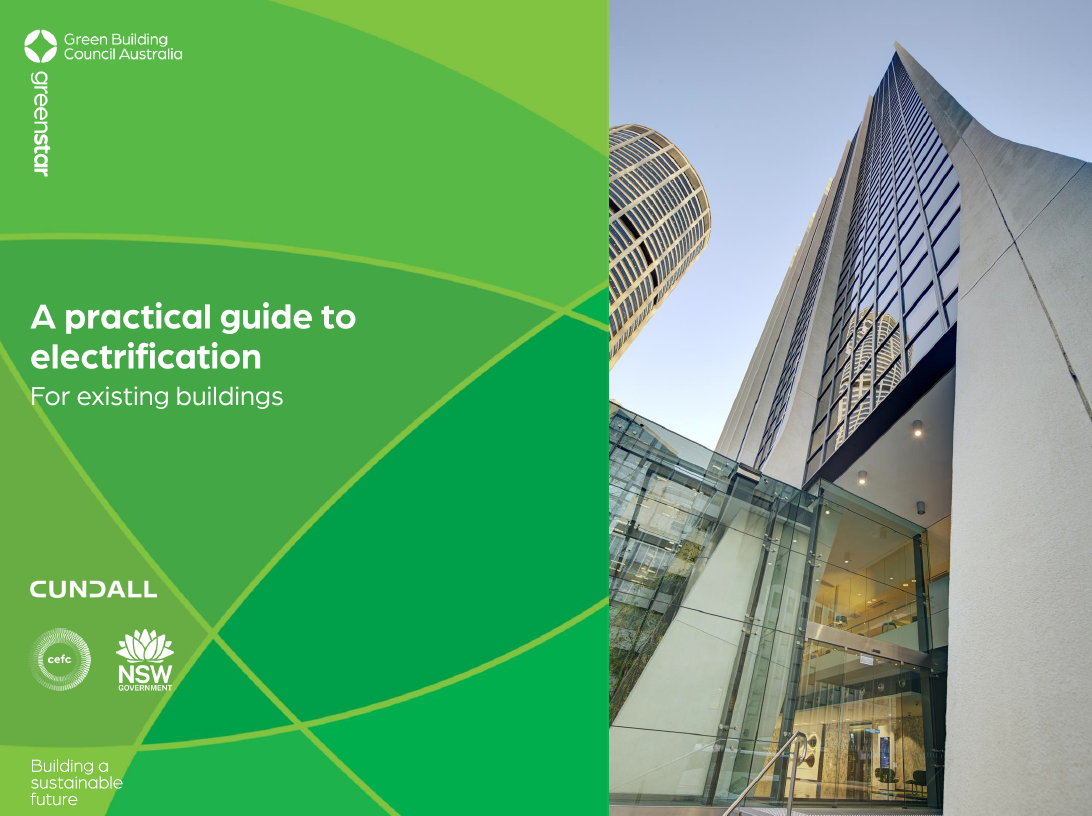
A practical guide to electrification (existing buildings)
Released in 2022, written by Green Building Council Australia, this guide outlines the steps involved in retrofitting existing buildings to be all-electric and the types of technologies that can be used today to replace natural gas systems. Intended users includes building owners, developers, facilities managers, consultants or building professionals.
Kicking the gas habit: How gas is harming our health
Released in 2021, written by Climate Council Australia, this resource outlines the health consequences of gas production and gas consumption, specifically hazards of gas use in cooking and indoor heating.
